

This post originally appeared on A Media Operator. You can read the full post here.
Your open rate is a lie. A structural distortion built into every major ESP. And almost nobody in this industry will talk about it plainly.
Every ESP — beehiiv, Mailchimp, Omeda, Sailthru, all of them — is choosing what number to show you. That choice is shaped by their business model, not yours. If you're a publisher selling advertising against those numbers, you need to understand how this works so you don't make the wrong decisions for your business.
The incentive nobody talks about
Customers think high open rates mean good deliverability. So ESPs, who sell deliverability as their core value proposition, have every incentive to show you a number that feels good. High open rates keep customers happy. Happy customers don't churn. It's that simple, and that perverse.
Remember this. Everything else flows from it.
The scale of the problem
At Workweek, we process our own raw email signals in-house. We built our own bot-filtering model because we wanted to know what was actually real. Here's what we found.
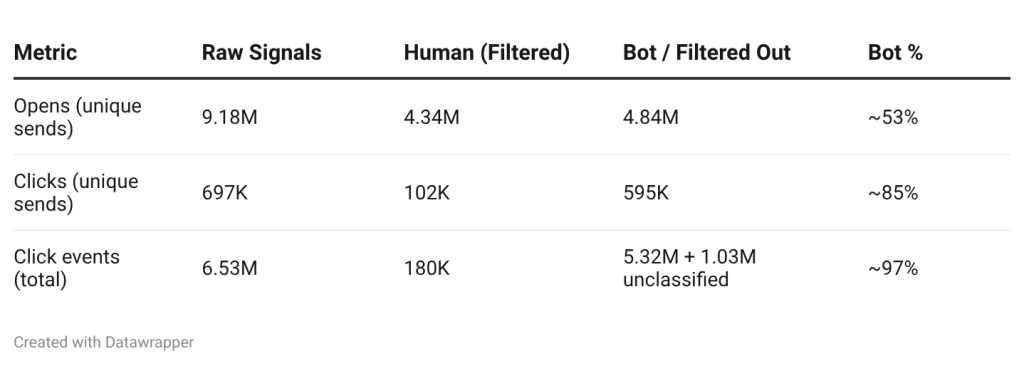
Up to 92% of total click events are non-human. Security scanners, link prefetchers, corporate mail proxies. Machines firing pixels and following links before a person ever touches the email.
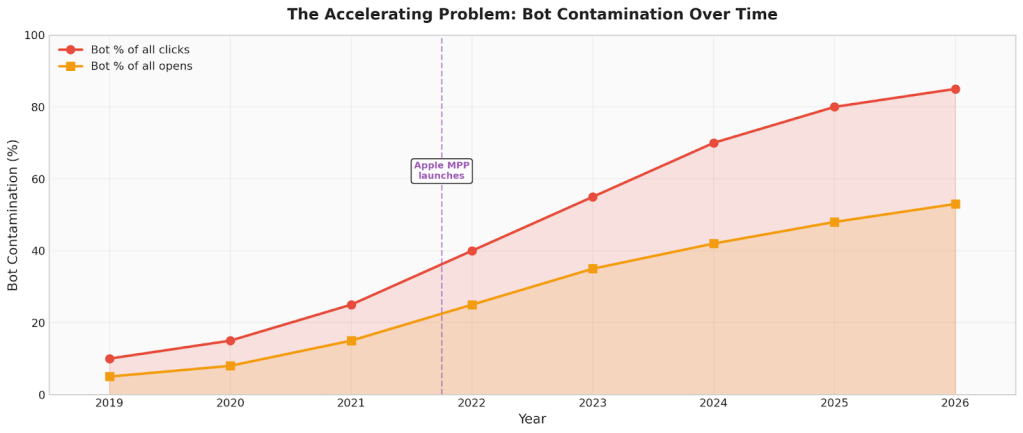
In 2019, only 5% of all opens were bots. Today it is 50%. That rate of change is the point. The problem is not stabilizing. It is accelerating, and the tools most publishers rely on were not built for this.
The algorithm every ESP has to build
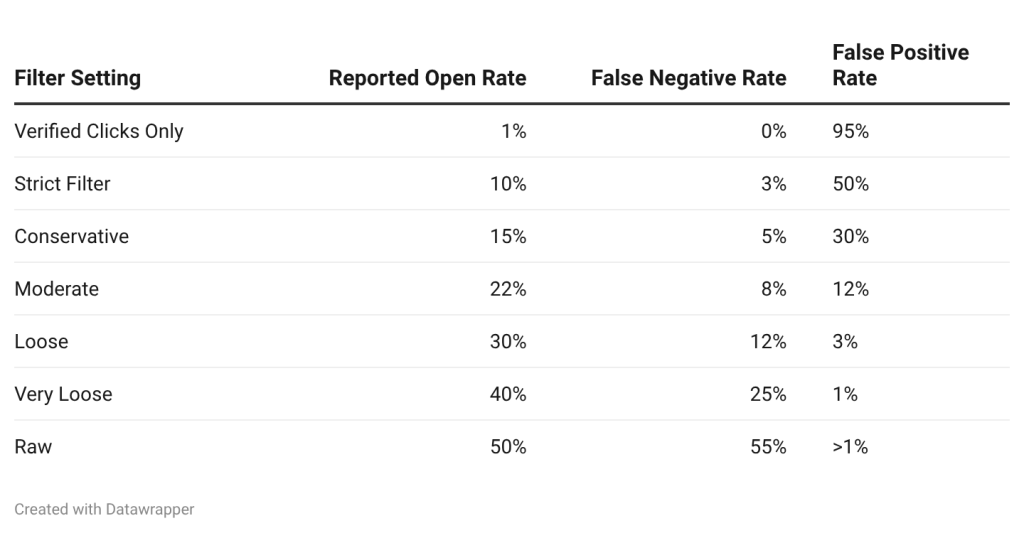
Every ESP has built a bot filter. The question isn't whether they filter. It's how they calibrate it. Every model makes two types of errors.
- False negative: a bot counted as a real open (inflates your rate).
- False positive: a real open flagged as a bot (deflates your rate).
Tighten the filter, you catch more bots but throw out real opens. Loosen it, you keep humans but let bots through. It's a dial. Most ESPs set it in the direction that keeps you from asking questions.
You can build a model that's 99.9% confident it's not counting bots as humans. But your false positive rate might hit 60%, and your reported open rate drops to around 5% — numbers that would make most publishers switch platforms overnight.
Two customers, one number
A pure ESP like SendGrid can set the dial to "comfortable" and move on. Their only customer is the sender. Nobody else is paying against those numbers.
But ESPs that also run ad networks have a problem they do not talk about. They serve two customers with opposing interests. Publishers want high numbers on their dashboard because high numbers mean premium CPMs. Advertisers want real numbers because they are the ones writing the check. The platform sits in the middle, operating the model that determines what counts, while collecting revenue from both sides.
If you charge on CPM, your open filtering needs to be airtight. If you charge on CPC, your click filtering needs to be pristine. When it is not, advertisers are paying for ghosts. The platform knows this. The advertisers are starting to figure it out. The only people still in the dark are the publishers who never looked under the hood.
You can serve two masters. You cannot serve two that are paying for opposite outcomes.
If you want real numbers, you have to build them
Unless you build your own filtering model, you're at the mercy of whatever your ESP decides to show you. Building your own requires raw data: every open signal, every click event, with timestamps. SendGrid and some others provide this, but most do not. They hand you the filtered number and call it a day.
If you can get the data and have the engineering talent to process it, you can calibrate a model to your own tolerance for error. That's what we did at Workweek. Most publishers are flying on instruments they didn't build, can't inspect, and don't control. With the open-source filter we published, you can do this a lot more easily.
When your open rate "changes" overnight
Here's a scenario: an ESP shifts reported opens by 5 to 10 percentage points overnight. Everyone panics. Was it deliverability? Content? Did something break?
Usually the answer is simpler: the ESP changed their bot filter. They moved the dial. Your audience didn't change. Your content didn't change. The ruler changed. Even the platform says nothing changed.
So. Do we care?
This isn't rhetorical. It's a forced choice.
- You can lean into honesty. Tell your advertisers: "A meaningful portion of the opens and clicks you've been paying against were bots. Here's what we believe the real numbers are." Brutal conversation. Might cost you revenue this quarter. But it builds trust that compounds over years.
- You can avoid it. Keep showing whatever your ESP gives you. Hope the algorithm doesn't change. Hope advertisers don't ask hard questions. This works until it doesn't, and when it stops, it stops all at once.
- Or you can punish the honest platforms. When an ESP gets more accurate and your open rates drop, threaten to leave. This tells every ESP in the market that honesty is a competitive disadvantage.
What has to happen
Display advertising went through this exact reckoning 15 to 20 years ago. Bot traffic was rampant, impression fraud was everywhere. The response wasn't to hope it got better. It was to create standards: third-party verification, audited methodologies, shared frameworks for what counts as a real impression.
Email needs the same thing. Open-source the bot-filtering models. There is nothing proprietary about pattern matching on user agents, IP behavior, timing signatures, and click cadences. The only reason these models are black boxes is because transparency would expose how much each platform lets through.
If the industry can't open-source individual models, create a shared standard. An independent body that defines what counts as a human open, a human click, and how confidence levels get reported — the same way the IAB standardized viewable impressions for display.
The least we can do
The open rate in your dashboard is not a measurement. It's a business decision made by someone else, shaped by incentives that don't align with yours.
The publishers who will be standing in five years are the ones who decided early that their relationship with advertisers was worth more than a few extra points on a vanity metric. The ones who looked at their own data, understood what was real, and had the conversation nobody wanted to have.
We don't need everyone to solve this tomorrow. But we need to stop pretending there's nothing to solve. If you want to run this yourself, the full framework is open source on GitHub. Star it, fork it, send it to your data team.
That's the least we can do.